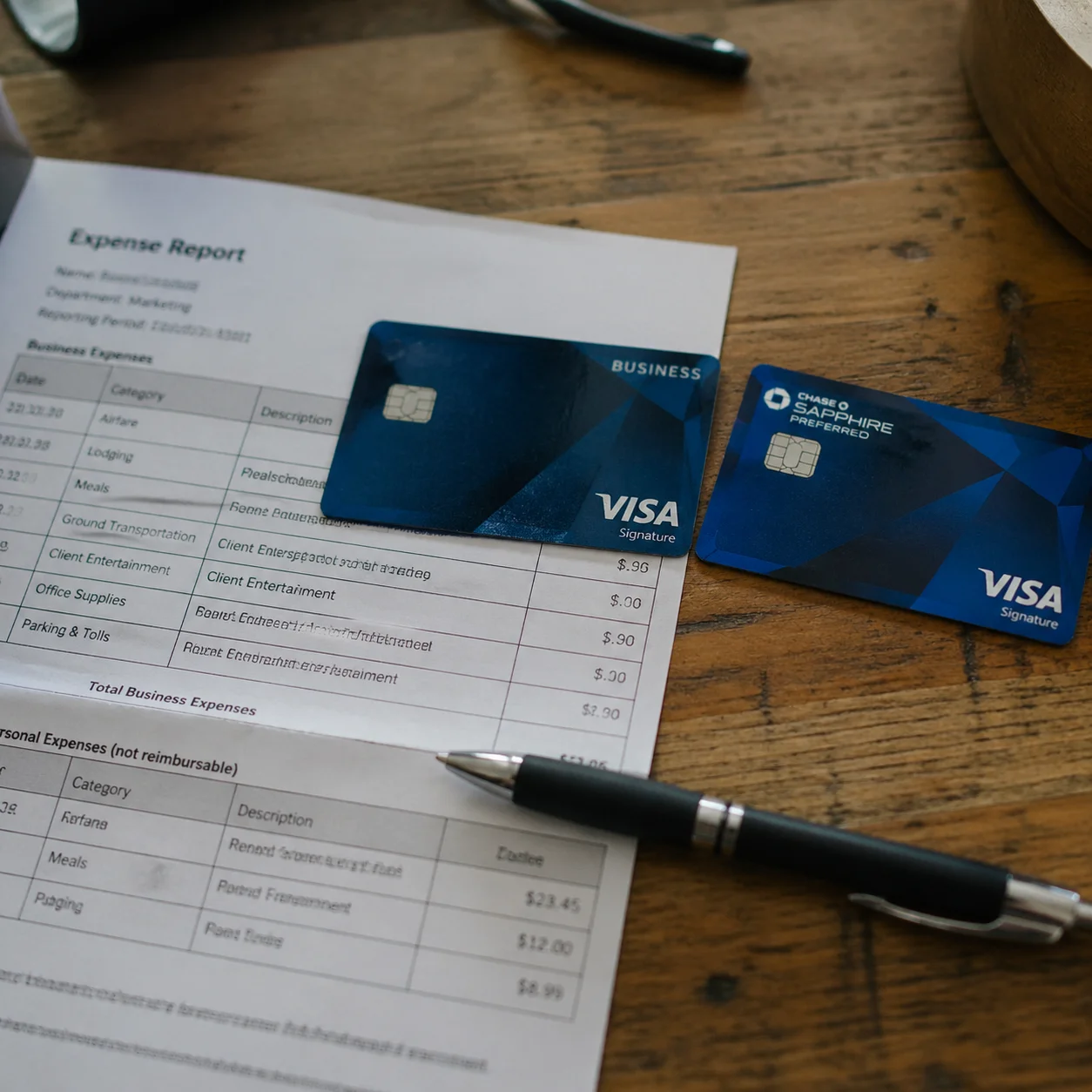
Choosing between a business credit card and a personal credit card is one of those decisions that looks simple on the surface but carries real consequences for your finances, your taxes, and even your legal exposure. Most people default to what they already have — a personal card — and use it for everything from office supplies to client dinners. That works, until it doesn’t.
The structural differences between these two card types go well beyond the name printed on the front. Understanding where they diverge — and where they overlap — can save you thousands of dollars annually and protect you from compliance headaches down the road.
How Business and Personal Credit Cards Are Structured Differently
At the most basic level, both card types let you borrow money up to a set limit and pay it back with or without interest. That’s where the similarities start to thin out.
Business credit cards are designed around the financial rhythms of a company: higher credit limits, expense categorization tools, and the ability to issue employee cards with individual spending caps. Personal cards, by contrast, are built around individual consumption — groceries, travel, subscriptions. The underwriting process reflects this: personal card issuers look at your individual credit score and income, while business card issuers often evaluate both personal credit and business revenue, especially for sole proprietors and early-stage companies.
One structural detail that many small business owners overlook: most business credit cards still require a personal guarantee. That means if the business defaults, the issuer can come after your personal assets. Some premium corporate cards — typically reserved for established businesses with strong financials — remove this requirement entirely, but those are the exception rather than the norm.
Beyond credit limits and guarantees, the day-to-day management tools differ considerably. Business cards often come with built-in dashboards that let you assign expense codes, download categorized statements in formats compatible with accounting software, and set recurring monthly alerts when individual cardholders approach their limits. These administrative features are largely absent from personal card portals, which are optimized for a single user reviewing a single statement — not a finance manager reconciling charges across a team of five or ten employees.
- Credit limits: Business cards routinely offer limits two to five times higher than comparable personal cards.
- Reporting: Many business cards do not report to personal credit bureaus under normal conditions, which can insulate your personal score from high utilization.
- Underwriting basis: Personal cards rely on individual credit history; business cards factor in business revenue and time in operation.
Liability and Legal Protections: A Critical Distinction
The Consumer Financial Protection Bureau (CFPB) enforces the Credit CARD Act of 2009 on personal credit cards, which provides meaningful consumer protections: limits on interest rate hikes, mandatory advance notice of changes, and clear billing dispute rights. Business credit cards are largely exempt from these provisions. Issuers can raise rates with shorter notice windows and have more flexibility in how they structure terms.
This is not a minor footnote. If your business card issuer decides to cut your credit limit overnight or ratchet up your APR after a missed payment, your recourse is narrower than it would be with a personal card. Before signing up for a business card, reading the cardholder agreement carefully — specifically the sections on rate changes and default terms — is worth the time investment.
On the flip side, business cards offer something personal cards cannot: a cleaner legal separation between personal and business finances. Mixing both through a single personal card can blur the line that protects your personal assets in the event of a lawsuit or audit. For LLCs and S-Corps in particular, keeping business expenses on a dedicated business card reinforces the “corporate veil” — the legal barrier between your personal wealth and business liabilities. An accountant I spoke with once described using a personal card for business expenses as “voluntarily dismantling your own firewall.” That framing stuck with me.
Rewards Programs: Which Card Actually Pays More?
Both card types offer rewards, but the categories differ significantly. Personal cards tend to optimize for consumer spending — dining, groceries, streaming services, and travel. Business cards are calibrated for commercial spending: office supplies, telecommunications, advertising, and shipping.
If your business spends heavily on digital advertising or software subscriptions, certain business cards offer 3x to 5x points per dollar in those categories — a multiplier that no personal card currently matches at scale. The American Express Business Gold Card, for example, offers 4x points on the two categories where the business spends the most each billing cycle (up to $150,000 annually). That kind of dynamic categorization simply does not exist in the personal card market.
Travel rewards are where the comparison gets murkier. Several premium personal cards — Chase Sapphire Reserve, for instance — offer lounge access, travel credits, and transfer partners that rival or exceed what business cards provide. For a solo founder who travels frequently, a premium personal travel card might outperform a business card on net rewards value, especially after accounting for annual fees.
- Best for business spending: Business cards with category multipliers on ads, telecom, and shipping.
- Best for mixed travel: Premium personal cards with flexible travel credits.
- Best for cash flow management: Business cards with extended payment windows or 0% introductory periods on purchases.
Tax Implications and Expense Tracking
One of the most practical arguments for using a business credit card is what happens every January. When business expenses run through a dedicated card, the year-end statement becomes a pre-sorted tax document. Categories like travel, advertising, and utilities are already broken out. When those same expenses are mixed with personal spending on a single card, you — or your bookkeeper — spend hours separating them manually.
The IRS does allow deductions for legitimate business expenses regardless of which card you use to pay for them. The problem is documentation and audit risk. A dedicated business card creates a clear paper trail. A personal card with mixed charges invites scrutiny and makes it harder to substantiate deductions if you’re ever reviewed.
Many business card issuers also offer direct integrations with accounting platforms like QuickBooks, Xero, or FreshBooks. Transactions sync automatically, categories are suggested, and receipts can be attached digitally. For a small business owner managing their own books, this feature alone can recoup hours every month. If you’re thinking about the broader picture of financing your business, understanding small business loan requirements alongside credit card options gives you a more complete view of what lenders and card issuers actually evaluate.
It’s also worth noting how these integrations affect year-round financial visibility, not just tax season. When every transaction is automatically categorized and flowing into your accounting software in real time, you can spot cost overruns in specific departments weeks earlier than you would if you were doing monthly manual reconciliation. That kind of early warning has genuine operational value — catching a runaway software subscription or an employee overspending on travel is far easier when the data is current rather than three months stale.
Building Business Credit vs. Personal Credit
Using a business credit card responsibly helps build a credit profile under your business’s EIN, separate from your personal Social Security number. Business credit bureaus — Dun & Bradstreet, Equifax Business, and Experian Business — maintain their own scoring models. A strong business credit profile can eventually allow you to access financing without a personal guarantee, negotiate better vendor terms, and qualify for higher-limit cards.
This matters most when you’re planning to scale. A freelancer running a one-person operation may not need a distinct business credit file today. But a business owner who anticipates hiring, leasing space, or seeking a line of credit within the next two to three years benefits from starting the business credit building process early.
Personal credit cards, used for business expenses, build only your personal credit — and can hurt it if business spending pushes your utilization ratio above 30%. Since personal credit scoring models penalize high utilization heavily, a busy quarter of business expenses on a personal card can temporarily drop your score by 20 to 40 points, even if you pay it off in full. For a deeper look at how different credit products interact with each other, comparing personal loans and credit cards for debt consolidation offers useful context on how lenders weigh these factors.
When a Personal Card Still Makes Sense for Business Use
There are legitimate scenarios where using a personal card for business expenses is a reasonable short-term choice. If your business is brand new and has no revenue history, you may not qualify for a business card with meaningful limits yet. Some sole proprietors operating at very low volumes find that the added complexity of a separate business card isn’t worth the administrative overhead at their current stage.
Personal cards also tend to carry stronger fraud protections under the CARD Act, and for very small purchases in low-risk categories, that extra legal layer can be worth something. Premium personal cards with strong purchase protection and extended warranty benefits may also outperform their business card counterparts for certain equipment purchases.
The key principle here: using a personal card for business is a temporary workaround, not a strategy. The moment your monthly business expenses exceed $1,500 to $2,000, the tax, credit, and liability arguments for a dedicated business card start to outweigh the convenience of keeping everything on one card. That threshold is not arbitrary — it’s roughly the point where category rewards and tax documentation time savings begin to generate measurable financial returns.
Conclusion
The choice between business and personal credit cards is not just a matter of preference — it’s a structural financial decision with downstream effects on your taxes, legal exposure, and creditworthiness. For most business owners past the startup phase, a dedicated business card is the more defensible choice: it builds a separate credit file, simplifies tax documentation, and provides spending tools that personal cards were never designed to offer. Start with a no-annual-fee business card if you’re early-stage, track whether category rewards align with your actual spending, and revisit the decision annually as your revenue grows. The card in your wallet should match the financial life you’re actually living, not the one that was easiest to apply for three years ago.
FAQ
Can I use a personal credit card for business expenses?
Yes, it’s legally allowed, but it’s generally not advisable long-term. Mixing personal and business expenses complicates tax filing, weakens your legal protection as a business entity, and can negatively affect your personal credit score through high utilization.
Do business credit cards affect personal credit scores?
Most major business card issuers do not report activity to personal credit bureaus during normal use — but they almost always report delinquencies. Additionally, the initial application typically triggers a hard inquiry on your personal credit, which causes a small, temporary score dip.
What credit score do I need to get a business credit card?
Most business cards require a personal credit score of at least 670 to 700, since personal guarantees are standard for small businesses. Some secured business cards are available for lower scores, but they require a cash deposit as collateral.
Are business credit card fees tax-deductible?
Yes, annual fees and interest paid on business credit cards are generally deductible as ordinary business expenses, provided the card is used exclusively or primarily for business purposes. Personal card fees are not deductible, even if you use the card partly for business.
How do employee cards work on business credit accounts?
Business cards typically allow you to issue additional cards to employees, each with its own spending limit that you control. Charges roll up to the primary account, and many issuers provide detailed per-card reporting, which makes expense auditing straightforward without requiring reimbursement workflows.
Can a business credit card help me qualify for a small business loan?
A well-managed business credit card contributes directly to your business credit file, which lenders review when evaluating loan applications. Consistent on-time payments and low utilization on a business card signal financial discipline and can meaningfully improve your chances of qualifying for a term loan or line of credit at favorable rates — particularly if your business is still too young to have an extensive financial history.

Daniel Cross is a financial writer and structural analyst focused on long-term market forces, systemic risk, and the incentives that shape real financial outcomes. His work emphasizes clarity, realism, and context over short-term market noise or speculative narratives.